you can also do dat by reffering me ...
Wednesday, July 14, 2010
Its my own "Love storY"

Its my own "Love storY"
Monday, June 28, 2010
Sweet Things to Say to Your Girlfriend

I love kissing with you
My girlfriend and me have been together for few years already. But still, everytime we kiss, I remember our first kiss (which, to be frank, was quite awful, I was thinking – is it me, or her – which one does not know how to kiss?).
However I remember my first kiss not because it was worst our kiss ever, but because every our other kisses are better and better. And, yes, i guess, it is hard to think like that after few years of kissing everyday. Anyway, I love kissing with my girlfriend and probably I should let her know that…
I love kissing with you..
Some more sweet things to say:
Sweet Kitty Bellairs

Weekend Labour days
Sweet Kitty Bellairs is a 1930 musical comedy film photographed entirely in Technicolor. In contrast to usual historical costume dramas, the picture never takes itself seriously and is a delightful satire of the England of 1793 in the city of Bath. The film pokes fun at such things as the way women dressed when they went bathing in the 18th century (we are shown in one sequence a pool in which women are dressed head to toe with their hats on!) or to how men viewed a woman's bare ankles with what seems today to be an inordinate amount of delight and satisfaction.
The cast, which includes Claudia Dell as Kitty Bellairs, Ernest Torrence as Sir Jasper, Walter Pidgeon as the young Lord Varney, Perry Askam, Lionel Belmore, and June Collyer, enjoy themselves thoroughly, are never called upon for much histrionic effort. The cinema is from David Belasco's play of the same name. Walter Pidgeon and Claudia Dell are the principal singers. They pleasantly sing two delightful romantic love songs.
Saturday, June 26, 2010
The Big Bang...
THE BIG BANG:
The Hubble Telescope's deepest view of the universe teaches us about the beginning
INTRODUCTION
We certainly know that our universe exists, however, this knowledge alone has not satisfied mankind's quest for further understanding. Our curiosity has led us to question our place in this universe and furthermore, the place of the universe itself. Throughout time we have asked ourselves these questions: How did our universe begin? How old is our universe? How did matter come to exist? Obviously, these are not simple questions and throughout our brief history on this planet much time and effort has been spent looking for some clue. Yet, after all this energy has been expended, much of what we know is still only speculation.
We have, however, come a long way from the mystical beginnings of the study of cosmology and the origins of the universe. Through the understandings of modern science we have been able to provide firm theories for some of the answers we once called hypotheses. True to the nature of science, a majority of these answers have only led to more intriguing and complex questions. It seems to be inherent in our search for knowledge that questions will always continue to exist.
Although in this short chapter it will be impossible to tackle all of the questions concerning the creation of everything we know as reality, an attempt will be made to address certain fundamental questions of our being. It will be important to keep in mind that all of this information is constantly being questioned and reevaluated in order to understand the universe more clearly. For our purposes, through an examination of what is known about the Big Bang itself, the age of the universe, and the synthesis of the first atoms, we believe that we can begin to answer several of these key questions.
THE BIG BANG
One of the most persistently asked questions has been: How was the universe created? Many once believed that the universe had no beginning or end and was truly infinite. Through the inception of the Big Bang theory, however,no longer could the universe be considered infinite. The universe was forced to take on the properties of a finite phenomenon, possessing a history and a beginning.
About 15 billion years ago a tremendous explosion started the expansion of the universe. This explosion is known as the Big Bang. At the point of this event all of the matter and energy of space was contained at one point. What exisisted prior to this event is completely unknown and is a matter of pure speculation. This occurance was not a conventional explosion but rather an event filling all of space with all of the particles of the embryonic universe rushing away from each other. The Big Bang actually consisted of an explosion of space within itself unlike an explosion of a bomb were fragments are thrown outward. The galaxies were not all clumped together, but rather the Big Bang lay the foundations for the universe.
The origin of the Big Bang theory can be credited to Edwin Hubble. Hubble made the observation that the universe is continuously expanding. He discovered that a galaxys velocity is proportional to its distance. Galaxies that are twice as far from us move twice as fast. Another consequence is that the universe is expanding in every direction. This observation means that it has taken every galaxy the same amount of time to move from a common starting position to its current position. Just as the Big Bang provided for the foundation of the universe, Hubbles observations provided for the foundation of the Big Bang theory.
Since the Big Bang, the universe has been continuously expanding and, thus, there has been more and more distance between clusters of galaxies. This phenomenon of galaxies moving farther away from each other is known as the red shift. As light from distant galaxies approach earth there is an increase of space between earth and the galaxy, which leads to wavelengths being stretched.
In addition to the understanding of the velocity of galaxies emanating from a single point, there is further evidence for the Big Bang. In 1964, two astronomers, Arno Penzias and Robert Wilson, in an attempt to detect microwaves from outer space, inadvertently discovered a noise of extraterrestrial origin. The noise did not seem to emanate from one location but instead, it came from all directions at once. It became obvious that what they heard was radiation from the farthest reaches of the universe which had been left over from the Big Bang. This discovery of the radioactive aftermath of the initial explosion lent much credence to the Big Bang theory.
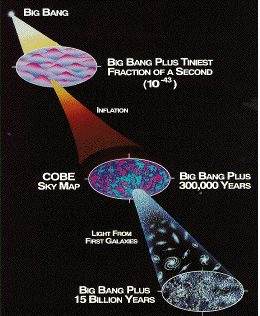 Even more recently, NASAs COBE satellite was able to detect cosmic microwaves eminating from the outer reaches of the universe. These microwaves were remarkably uniform which illustrated the homogenity of the early stages of the universe. However, the satillite also discovered that as the universe began to cool and was still expanding, small fluctuations began to exist due to temperature differences. These flucuatuations verified prior calculations of the possible cooling and development of the universe just fractions of a second after its creation. These fluctuations in the universe provided a more detailed description of the first moments after the Big Bang. They also helped to tell the story of the formation of galaxies which will be discussed in the next chapter.
The Big Bang theory provides a viable solution to one of the most pressing questions of all time. It is important to understand, however, that the theory itself is constantly being revised. As more observations are made and more research conducted, the Big Bang theory becomes more complete and our knowledge of the origins of the universe more substantial.
THE FIRST ATOMS
Now that an attempt has been made to grapple with the theory of the Big Bang, the next logical question to ask would be what happened afterward? In the minuscule fractions of the first second after creation what was once a complete vacuum began to evolve into what we now know as the universe. In the very beginning there was nothing except for a plasma soup. What is known of these brief moments in time, at the start of our study of cosmology, is largely conjectural. However, science has devised some sketch of what probably happened, based on what is known about the universe today.
Immediately after the Big Bang, as one might imagine, the universe was tremendously hot as a result of particles of both matter and antimatter rushing apart in all directions. As it began to cool, at around 10^-43 seconds after creation, there existed an almost equal yet asymmetrical amount of matter and antimatter. As these two materials are created together, they collide and destroy one another creating pure energy. Fortunately for us, there was an asymmetry in favor of matter. As a direct result of an excess of about one part per billion, the universe was able to mature in a way favorable for matter to persist. As the universe first began to expand, this discrepancy grew larger. The particles which began to dominate were those of matter. They were created and they decayed without the accompaniment of an equal creation or decay of an antiparticle.
As the universe expanded further, and thus cooled, common particles began to form. These particles are called baryons and include photons, neutrinos, electrons and quarks would become the building blocks of matter and life as we know it. During the baryon genesis period there were no recognizable heavy particles such as protons or neutrons because of the still intense heat. At this moment, there was only a quark soup. As the universe began to cool and expand even more, we begin to understand more clearly what exactly happened.
After the universe had cooled to about 3000 billion degrees Kelvin, a radical transition began which has been likened to the phase transition of water turning to ice. Composite particles such as protons and neutrons, called hadrons, became the common state of matter after this transition. Still, no matter more complex could form at these temperatures. Although lighter particles, called leptons, also existed, they were prohibited from reacting with the hadrons to form more complex states of matter. These leptons, which include electrons, neutrinos and photons, would soon be able to join their hadron kin in a union that would define present-day common matter.
After about one to three minutes had passed since the creation of the universe, protons and neutrons began to react with each other to form deuterium, an isotope of hydrogen. Deuterium, or heavy hydrogen, soon collected another neutron to form tritium. Rapidly following this reaction was the addition of another proton which produced a helium nucleus. Scientists believe that there was one helium nucleus for every ten protons within the first three minutes of the universe. After further cooling, these excess protons would be able to capture an electron to create common hydrogen. Consequently, the universe today is observed to contain one helium atom for every ten or eleven atoms of hydrogen.
While it is true that much of this information is speculative, as the universe ages we are able to become increasingly confident in our knowledge of its history. By studying the way in which the universe exists today it is possible to learn a great deal about its past. Much effort has gone into understanding the formation and number of baryons present today. Through finding answers to these modern questions, it is possible to trace their role in the universe back to the Big Bang. Subsequently, by studying the formation of simple atoms in the laboratory we can make some educated guesses as to how they formed originally. Only through further research and discovery will it be possible to completely understand the creation of the universe and its first atomic structures, however, maybe we will never know for sure.
Sachin Tendulkar

Early years and personal life
Tendulkar was born in Bombay (now Mumbai). His father, Ramesh Tendulkar, a Marathi novelist, named Tendulkar after his favourite music director, Sachin Dev Burman. Tendulkar's elder brother Ajit encouraged him to play cricket. Tendulkar has two other siblings: a brother Nitin, and sister Savita.
Tendulkar attended Sharadashram Vidyamandir (High School),[1] where he began his cricketing career under the guidance of his coach and mentor, Ramakant Achrekar. During his school days he attended the MRF Pace Foundation to train as a fast bowler, but Australian fast bowler Dennis Lillee, who took a world record 355 Test wickets, was unimpressed, suggesting that Tendulkar focus on his batting instead.[19]
When he was young, Tendulkar would practice for hours on end in the nets. If he became exhausted, Achrekar would put a one-Rupee-coin on the top of the stumps, and the bowler who dismissed Tendulkar would get the coin. If Tendulkar passed the whole session without getting dismissed, the coach would give him the coin. Tendulkar now considers the 13 coins he won then as some of his most prized possessions.[20]
While at school, he developed a reputation as a child prodigy. He had become a common conversation point in Mumbai circles, where there were suggestions already that he would become one of the greats. His season in 1988 was extraordinary, with Tendulkar scoring a century in every innings he played. He was involved in an unbroken 664-run partnership in a Lord Harris Shield inter-school game in 1988 with friend and team mate Vinod Kambli, who would also go on to represent India. The destructive pair reduced one bowler to tears and made the rest of the opposition unwilling to continue the game. Tendulkar scored 326* in this innings and scored over a thousand runs in the tournament.[21] This was a record partnership in any form of cricket until 2006, when it was broken by two under-13 batsmen in a match held at Hyderabad in India.
When he was 14, Indian batting legend Sunil Gavaskar gave him a pair of his own ultra light pads. "It was the greatest source of encouragement for me," he said nearly 20 years later after surpassing Gavaskar's world record of 34 Test centuries.[22] On 24 May 1995[23], Sachin Tendulkar married Anjali, a paediatrician and daughter of Gujarati industrialist Anand Mehta. They have two children, Sara (born 12 October 1997), and Arjun (born 24 September 1999).[24]
Tendulkar sponsors 200 underprivileged children every year through Apnalaya, a Mumbai-based NGO associated with his mother-in-law, Annabel Mehta.[25]
Captaincy
Tendulkar's two tenures as captain of the Indian cricket team were not very successful. When Tendulkar took over as Captain in 1996, it was with huge hopes and expectations. However, by 1997 the team was performing poorly. Azharuddin was credited with saying "Nahin jeetega! Chote ki naseeb main jeet nahin hai!",[49] which translates into: "He won't win! It's not in the small one's destiny!".[50]
Tendulkar, succeeding Azharuddin as captain for his second term, then led India on a tour of Australia, where the visitors were comprehensively beaten 3–0 by the newly crowned world champions.[51] Tendulkar, however, was at his usual best and won the player of the tournament award as well as player of the match in one of the games. After another Test series defeat, this time by a 0–2 margin at home against South Africa, Tendulkar resigned, and Sourav Ganguly took over as captain in 2000.
Tendulkar remains an integral part of the Indian team's strategic processes. He is often seen in discussion with the captain, at times actively involved in building strategies. Former captain Rahul Dravid publicly acknowledged that Tendulkar had been suggesting moves such as the promotion of Irfan Pathan up the batting order which, although only temporary, had an immediate effect on the team's fortunes.
Wednesday, June 23, 2010
Real history of Taliban
Leith Knight of Australia writes on Saturday, November 24, 2001

That Osama bin Laden "admission"
I TOO NOTED those odd [Daily Telegraph] headlines that Osama bin Laden had suddenly admitted it too.
Bamber's report actually said that Osama made the comments in an al-Q'aeda training video, rather than the interview with a Pakistani journalist.
This video was supposed to have been released two Wednesday's ago as the centrepiece of the US and British case that Osama was guilty for the September 11 attacks. It's never been released, to my knowledge.
I emailed The Daily Telegraph a week ago about it, but never received a reply.
Some rather bizarre comments are attributed to Osama in the report, such as "History should be a witness that we are terrorists. Yes, we kill their innocents". I think I'll look further into this now that exams are over.
Related items on this website:
